Why isn't my dryer heating?
A blown thermal fuse, a failed heating element, or a faulty thermostat are the most common causes.

Same-Day Service · Upfront Pricing · 12-Month Warranty
If you're reading this standing next to a dryer that's making a noise it's never made before, or one that ran for 90 minutes and your towels are still damp, you're not losing your mind, and you're not alone.
This page is everything we know about dryer repair Sarasota FL homeowners actually deal with, written by people who fix these machines in this county every week.
This isn't marketing talk, it's physics. Sarasota sits at sea level on the Gulf, and from roughly May through October, outdoor humidity regularly sits above 80-90%. Your dryer's whole job is to push moisture out of a load of laundry. When the air it's pulling in is already saturated, the machine has to work harder and longer to hit the same result, which is exactly why so many dryer repair sarasota calls we get aren't actually broken dryers at all, just overworked ones losing the fight against the weather.
Add salt air rolling in off Sarasota Bay and the Gulf, and you get a second problem: corrosion. Electrical contacts, igniter components, and moisture sensors on units within a few miles of the coast, think Siesta Key (34242), Lido Key, and Longboat Key (34228), wear out measurably faster than the same parts on a dryer in, say, Fruitville or Lakewood Ranch. If you've ever wondered why your neighbor's dryer near the beach needed a new sensor at year six and yours inland lasted twelve, that's why.
Then there's the seasonal population swing that makes Sarasota genuinely different from most cities you'll find generic repair content written for. A huge share of homes here, in Palmer Ranch, The Meadows, Longboat Key, University Park, sit empty from late spring through fall while owners are up north. A dryer that hasn't run in five months, sitting in a closed-up house, is a specific kind of problem: dust and lint settled in the vent, the occasional gecko or palmetto bug that's taken up residence in the exhaust line, and a machine that hasn't been "exercised" in half a year. We see this every single November when the snowbirds come back.
A blown thermal fuse, a failed heating element, or a faulty thermostat are the most common causes.
Almost always a clogged lint screen or vent line restricting airflow this also raises fire risk, so it should be addressed quickly.
Once a year for most households, more often for larger families or short-term rental properties with heavy use.
Usually a worn drum support roller, a failing idler pulley, or a worn drive belt.
A blown thermal fuse, a failed heating element, or a faulty thermostat are the most common causes.
Almost always a clogged lint screen or vent line restricting airflow this also raises fire risk, so it should be addressed quickly.
Once a year for most households, more often for larger families or short-term rental properties with heavy use.
Usually a worn drum support roller, a failing idler pulley, or a worn drive belt.
Here's what actually shows up on our service calls across the county, not a generic list pulled from a manufacturer's manual.
Every one of these has a real fix, and most are completed same day because we stock the parts that fail most often in this climate, not because we're guessing.
If you're near Sarasota Memorial Hospital, St. Armands Circle, Marina Jack, or the UTC Mall corridor, you're well within our normal service radius, along with everywhere listed above.
We get asked this a lot, and the answer matters because the failure points are genuinely different.
The usual culprits are a failed igniter (won't light, so no heat), a bad gas valve coil, or a flame sensor issue.
If you smell gas at any point, not just a burning-lint smell, an actual gas odor, turn off the gas supply valve, don't touch any switches, leave the house, and call your gas provider before calling us. That's not us being overly cautious; that's just how gas safety works.
Almost always a heating element, thermal fuse, or thermostat problem. Electric dryers run on a dedicated 240V circuit, so if you're also seeing a tripped breaker, we check the circuit itself, not just the dryer.
Both types share the same vent and lint issues that Sarasota's humidity makes worse, that part doesn't care what fuel you use.
We'd rather tell you real numbers than make you call for a "free estimate" that's really just a sales visit. Ranges below reflect what we typically see:
| Repair | Typical Range |
|---|---|
| Diagnostic visit | $75 to $100 |
| Thermal fuse or thermostat replacement | $120 to $180 |
| Heating element replacement | $150 to $250 |
| Belt replacement | $150 to $220 |
| Drum roller / bearing replacement | $160 to $260 |
| Motor replacement | $220 to $350 |
| Vent clearing (coastal/humid homes) | $100 to $175 |
| Gas igniter or valve coil | $180 to $280 |
Repair or replace? As a rough rule: if the repair costs less than half the price of a new comparable dryer, and the unit is under 10 years old, repair almost always makes sense. Past that age, especially if this is your second repair in two years, we'll tell you honestly if replacement is the better move, we'd rather you trust us on the small jobs than oversell you on a repair that doesn't make financial sense.
Before you call anyone, run through this, it'll save you a diagnostic fee if the fix is something you can do yourself, and it'll help whoever you do call get to the real issue faster.
This is the part of the page most repair companies skip, and it shouldn't be skipped.
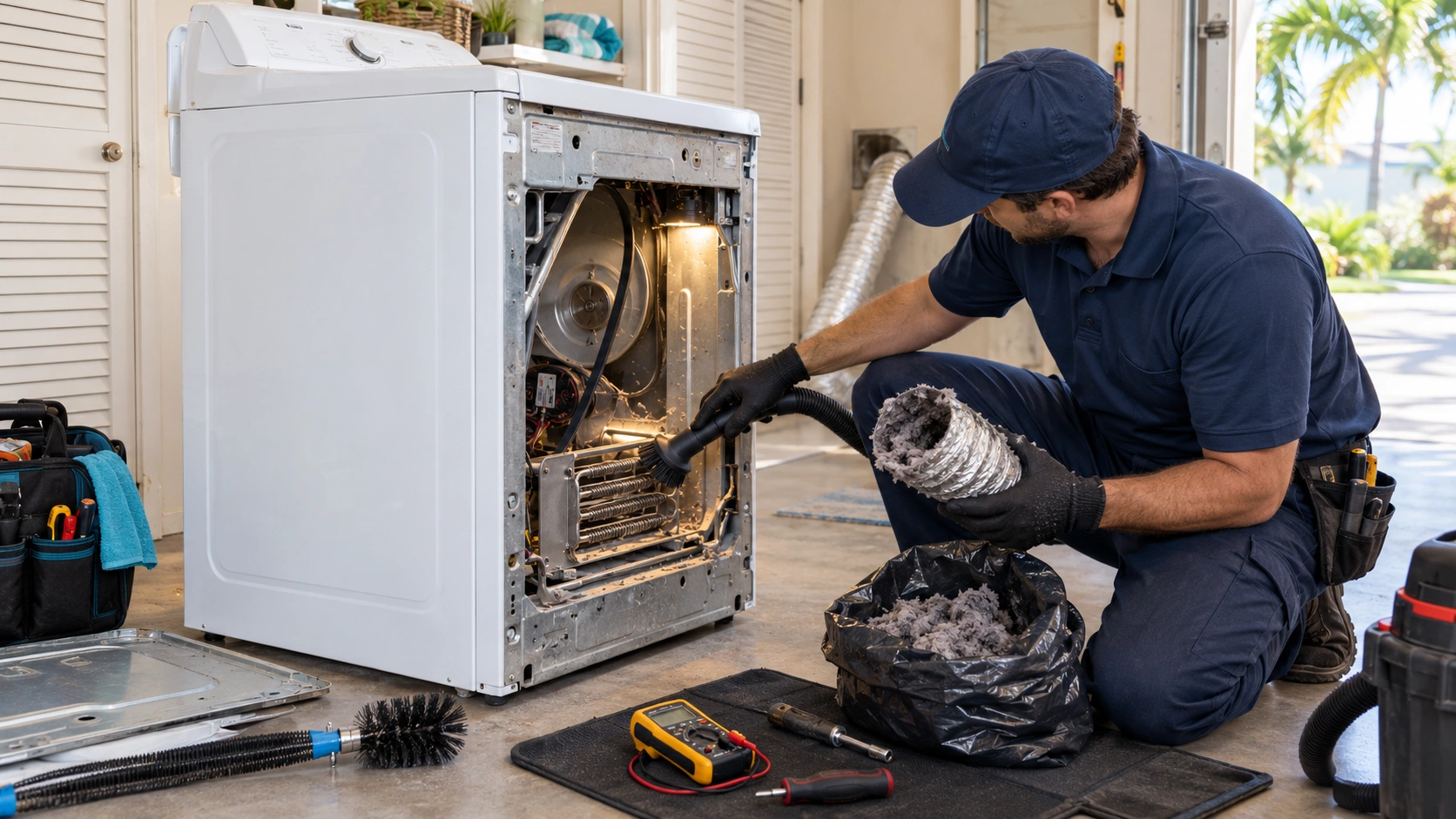
Household clothes dryers are linked to more than 15,000 fires across the country every year, causing roughly 15 deaths and close to $100 million in property damage. The mechanism is almost always the same: lint builds up inside the vent system and behind the dryer itself. Lint is highly combustible, and once enough of it accumulates, it makes the dryer run hotter than it should, which is exactly the condition that leads to ignition.
Fire safety researchers who've staged controlled demonstrations of this exact scenario have found that smoke can appear within seconds of ignition, flames reach nearby clothing or laundry within about a minute, and a typical laundry room can be fully engulfed in well under fifteen minutes. That's not a slow-building problem, once it starts, it moves fast.
Two things fire safety experts specifically recommend, and we back both of them:
Sarasota's snowbird and seasonal-home pattern means a lot of dryers sit unused and unchecked for months at a time, exactly the setup where vent lint builds up without anyone noticing. And hurricane season (June through November) brings power surges that put extra stress on aging electrical components in a dryer that's already due for a checkup. If your dryer is more than 8 years old, or you honestly can't remember the last time the vent was professionally cleaned, that's worth handling before storm season, not during it.
If you ever see smoke or flame coming from your dryer: don't try to put it out yourself. Get out of the house, get everyone else out, and call 911 from somewhere safe. That's what every fire safety professional recommends, and it's the right call every time.
Dryers typically last about 13 years. The dryer FAQ lists common thermal fuse, heating element, and belt repairs at $120 to $260, while vent clearing near the coast is $100 to $175. Compare the diagnosed repair with half the cost of a comparable new dryer to apply the 50% rule.
A thermal fuse may open after overheating, and clearing the airflow restriction can help prevent a repeat failure. A heating element can restore heat when the drum and controls remain sound, while a drive belt is a focused repair when the motor turns but the drum no longer tumbles.
Vent clearing is worth doing regardless of dryer age because lint can restrict airflow and create a fire risk. A motor failure or damaged drum on a dryer past 12 years is a stronger replacement signal, since those major repairs come on a unit nearing its typical lifespan.
Coastal humidity can make lint clump in the vent and along the exhaust path, narrowing airflow and making drying take longer. Restricted airflow keeps heat inside the dryer, which can stress the thermal fuse and heating element and increase fire risk. Check the full vent route as well as the appliance so a new part is not asked to operate against a blocked exhaust.
Still not sure? Read our repair or replace guide, or call us for an honest assessment. We will tell you when replacement makes more sense.
Most of the time it's humidity combined with a partially restricted vent, the dryer is fighting saturated outside air on top of normal lint buildup. Clean the vent and trap first; if it's still slow after that, a moisture sensor may need replacing.
Most common repairs, thermal fuse, belt, or heating element, run between $120 and $260 including parts and labor. Vent-clearing visits, more common near the coast, typically run $100 to $175.
If the repair costs less than half of a replacement unit's price, yes. If you've had two failures in the past two years, we'll tell you honestly if replacement makes more sense.
Yes, in most cases, for both gas and electric dryers, across Sarasota, Siesta Key, Longboat Key, Palmer Ranch, and the surrounding areas.
At least once a year. If you're a seasonal resident who's away for several months, have it checked when you return before running a full load.
Both. Gas dryer issues most often involve the igniter or gas valve coil; electric issues most often involve the heating element or thermal fuse.
Treat it as one. Stop using it immediately. If you see any smoke or flame, get everyone out of the house and call 911 before doing anything else.
Whether it's a dryer that won't heat in Fruitville or a vent that hasn't been touched since before last hurricane season on Longboat Key, we'd rather fix it right the first time than have you calling someone else in six months.